Virtual Assistant Onboarding: Complete 30-Day Playbook with Checklists
Paula Tellez
A comprehensive guide for successfully onboarding virtual assistants from Latin America, with week-by-week frameworks, downloadable templates, and proven best practices.
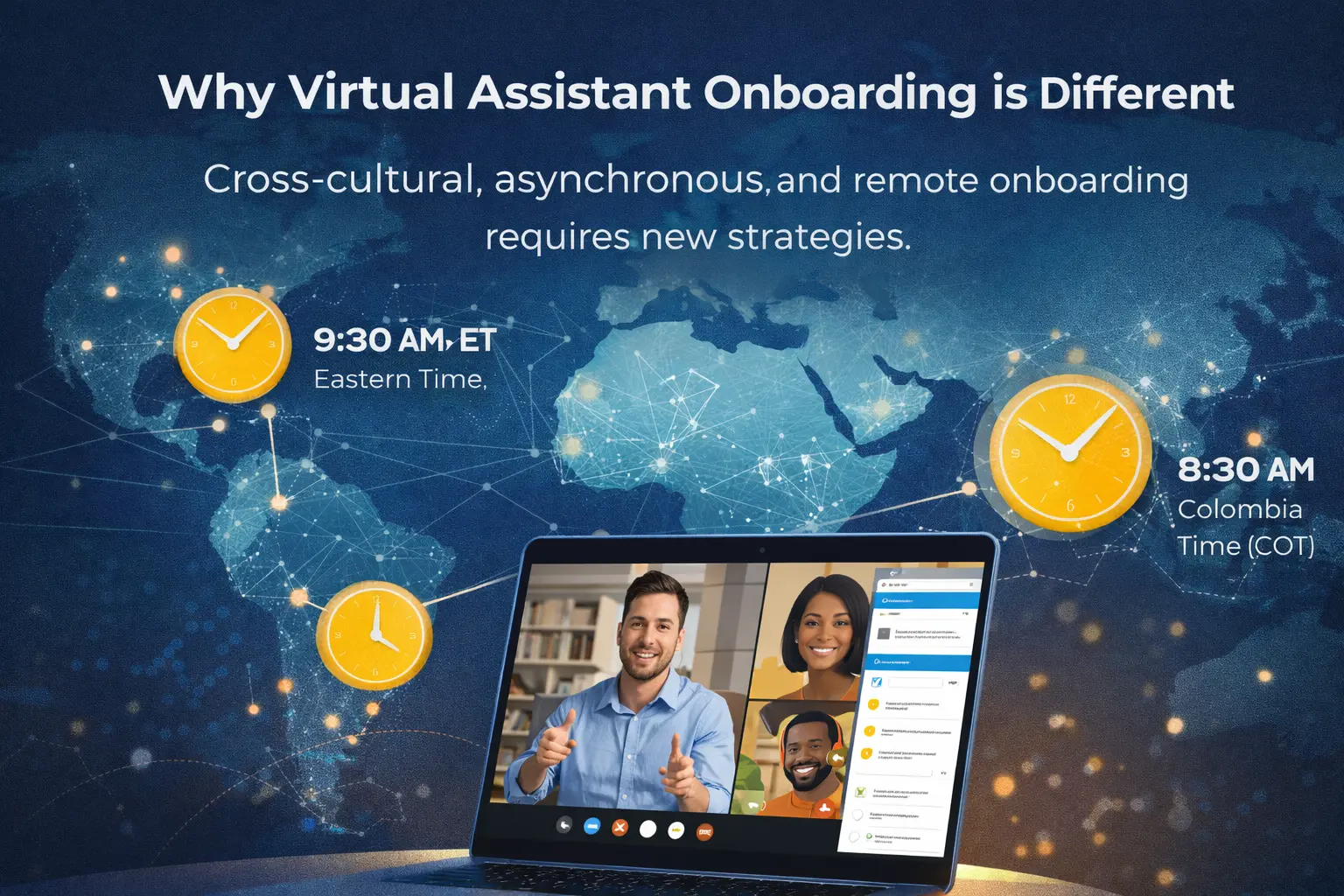
Section 1: Why Virtual Assistant Onboarding is Different
Onboarding a virtual assistant—especially from Latin America—requires a fundamentally different approach than traditional in-office hiring. The success of your VA relationship hinges on those critical first 30 days, where you establish communication patterns, build trust across time zones, and create the foundation for long-term productivity.
Unlike hiring a local employee where you can walk them through processes in person, virtual assistant onboarding demands intentional structure, documented procedures, and proactive communication. The four pillars that make VA onboarding unique are:
Cultural Onboarding (LATAM-Specific)
Latin American professionals bring exceptional work ethic, dedication, and professionalism, but they may approach workplace communication differently than US-based teams. Colombian and broader LATAM work culture emphasizes relationship-building, respect for hierarchy, and indirect communication styles. Your onboarding process should explicitly address these differences:
Communication norms: US professionals often favor direct, brief communication; LATAM professionals may use more formal language and context-setting
Feedback culture: Constructive criticism should be delivered with sensitivity and clear examples
Decision-making authority: Clarify when your VA should make independent decisions versus escalate to you
Relationship building: Invest time in personal connection—ask about their background, interests, and career goals
Time Zone Management
Colombia operates on Colombia Time (COT), which aligns closely with US Eastern Time with no daylight saving adjustments. This creates a natural advantage for US companies, but you must still establish explicit working hour expectations:
Define core collaboration hours when both parties are available for synchronous communication
Establish response time expectations for emails, Slack messages, and urgent requests
Set up asynchronous work protocols so your VA can be productive outside live collaboration hours
Account for Colombian holidays and vacation schedules (which differ from US holidays)
Compliance and Legal Setup
Hiring from Latin America involves unique legal and compliance considerations. Whether you're using an Employer of Record (EOR) model, hiring as an independent contractor, or directly employing your VA, you must address:
Independent contractor agreements with clear IP ownership, confidentiality clauses, and termination terms
Tax reporting requirements (Form 1099 for US companies paying contractors $600+)
Payment processing for international transfers (Wise, PayPal, Payoneer, or direct bank transfer)
Data security and compliance if your VA will access sensitive customer or business information
Tools Configuration
Remote work demands a robust tech stack. Your VA needs access to communication, project management, and specialized tools from day one. Unlike in-office onboarding where you can walk someone through software, virtual onboarding requires:
Pre-provisioned access to all systems (email, Slack, project management, CRM, etc.)
Written setup guides with screenshots for each tool
Video tutorials or screen recordings for complex processes
Equipment requirements (laptop, monitor, internet speed, backup power if needed)
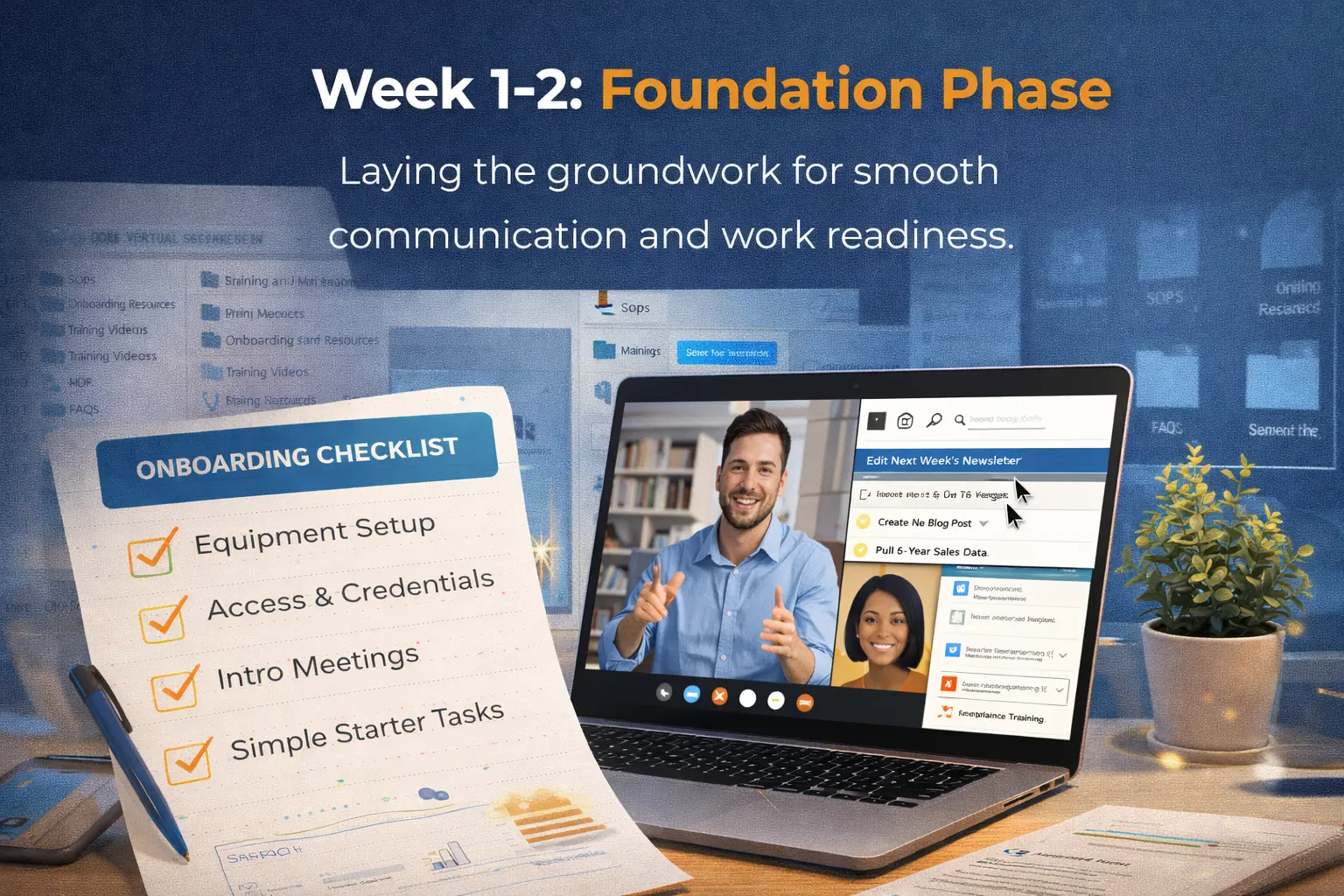
The first two weeks set the tone for your entire working relationship. This phase focuses on foundational setup, initial task exposure, and establishing communication rhythms. Your goal is to make your VA feel welcomed, equipped, and confident in their role.
The Week Before Start Date
Preparation before your VA's first day is critical. Complete these tasks 5-7 days before their start date:
Equipment and Access Setup
Verify your VA has necessary equipment (laptop, reliable internet, backup power if in regions with power instability)
Create email account and send welcome email with first-day schedule
Provision access to all systems: Slack, project management (Asana/Monday.com), Google Workspace/Microsoft 365, CRM, password manager
Send login credentials via secure method (password manager share or encrypted email)
Share company handbook, brand guidelines, and any compliance/security training materials
Documentation Preparation
Compile all existing SOPs (Standard Operating Procedures) relevant to your VA's role
Create a centralized onboarding folder with setup guides, FAQs, and training materials
Record Loom or screen-share videos for complex workflows your VA will handle
Draft initial task list for Week 1 (start with simple, low-stakes tasks to build confidence)
Team Communication
Notify your team of the new VA's start date and role
Schedule introductory meetings with key team members
Assign an onboarding buddy if possible (someone the VA can ask 'quick questions' without bothering you)
Day 1: Welcome and Orientation
First impressions matter. Your VA should finish Day 1 feeling welcomed, clear on expectations, and equipped to start contributing.
Morning: Welcome Call (60-90 minutes)
Personal introduction: Share your background, company story, mission, and values
Role clarity: Explain their position, key responsibilities, success metrics, and growth opportunities
Communication expectations: Define preferred channels (Slack for quick questions, email for formal, Zoom for weekly check-ins), response time standards, and working hours
Team structure: Explain org chart, who they'll work with most, and reporting relationships
Cultural context: Acknowledge you're learning to work together across cultures; encourage questions and feedback
Afternoon: Tools Setup and Access Verification
Screen-share session to verify access to all systems
Walk through primary tools: email, Slack etiquette, project management board, file storage structure
Set up password manager and enable two-factor authentication
Share onboarding folder location and ask them to review documentation by end of day
End of Day 1: First Small Task
Assign a simple, confidence-building task: 'Please review our company About page and send me 3 things you learned about our mission.' This gives them an easy win and provides a natural opportunity for follow-up conversation.
Days 2-7: Task Ramp-Up and SOPs Training
Week 1 focuses on structured learning and task exposure. Your VA should spend approximately 60% of their time on training and 40% on real tasks.
Daily Structure
Morning stand-up or async check-in: '3 things I'll accomplish today'
Focused work blocks: 2-hour segments with specific training modules or tasks
End-of-day recap: 'What I completed, what I learned, what I'm stuck on'
Progressive Task Assignment
Days 2-3: Administrative Tasks
Organize shared drive folders
Update contact database or CRM
Calendar management practice (schedule mock meetings)
Days 4-5: Core Responsibility Introduction
Assign first real deliverable (e.g., draft email, research report, social media post)
Shadow you or team member on a customer call or internal meeting
Practice using primary software (CRM entry, project management updates, etc.)
Days 6-7: Feedback and Adjustment
Review work completed during Week 1
Provide constructive feedback on one task (be specific: 'This was great because...' and 'Next time, try...')
Ask: 'What's been most challenging?' and 'What do you need more clarity on?'
Week 1 Onboarding Checklist
Use this 15-item checklist to ensure nothing falls through the cracks:
☐ Email account created and welcome email sent
☐ Access provisioned for all required tools
☐ Password manager and 2FA enabled
☐ Welcome call completed (60-90 minutes)
☐ Team introductions scheduled and completed
☐ Onboarding documentation reviewed
☐ Communication protocols explained and documented
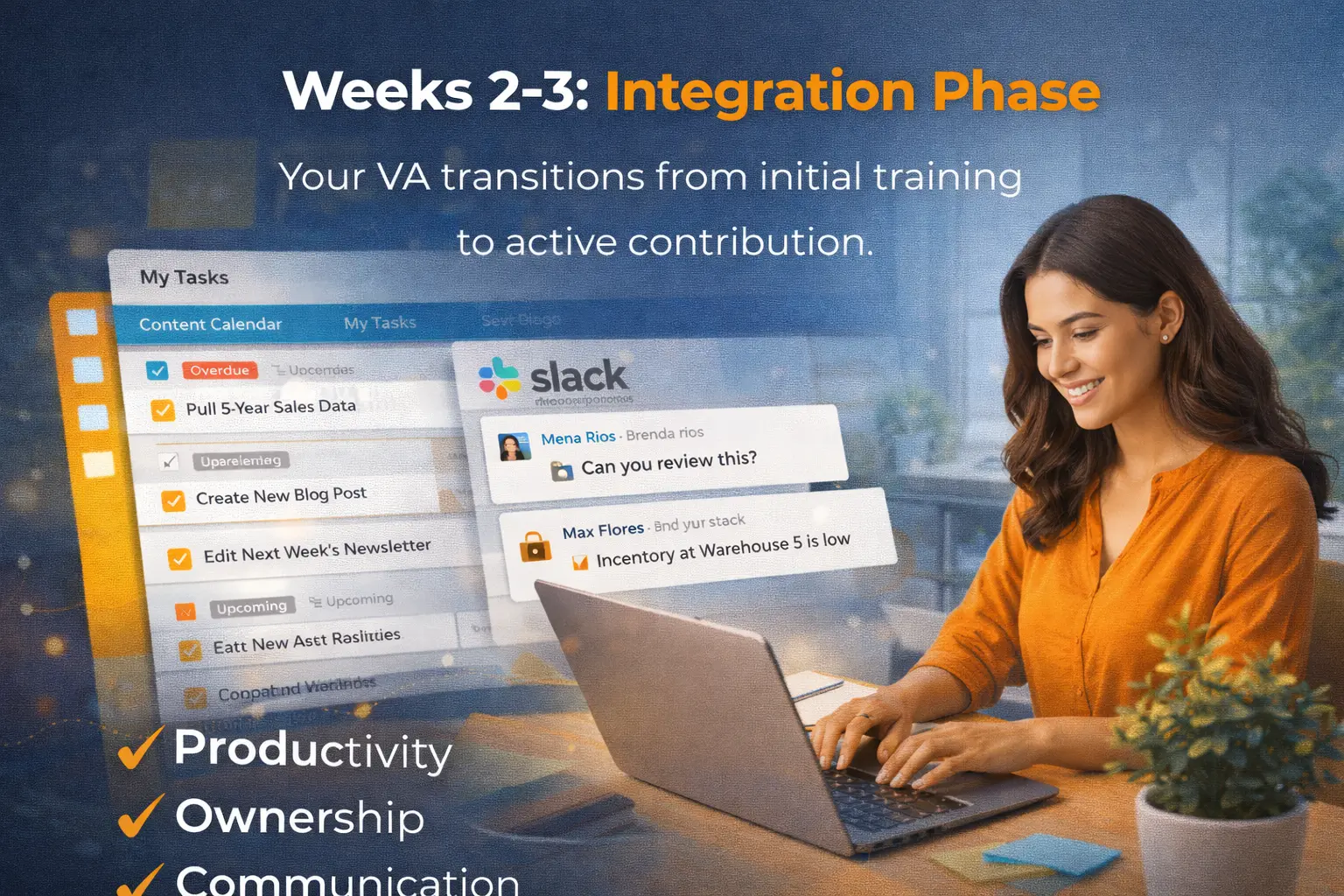
Weeks 2-3 transition your VA from 'learning mode' to 'contributing mode.' They should now handle real responsibilities with decreasing supervision while you establish performance baselines and refine communication patterns.
Task Assignment Increase
By Week 2, your VA should spend 70-80% of their time on productive work and 20-30% on continued learning. Gradually increase task complexity and volume:
Project-based work: Assign a small project with defined deliverable and 1-week deadline
Customer-facing tasks: If applicable, allow supervised customer interaction (draft emails, support tickets under review)
Cross-training: Introduce secondary responsibilities outside core role to build versatility
Week 3 Milestone: Full Task Load
By Week 3, your VA should be operating at or near full capacity. The goal is to normalize their workload so Week 4 assessment reflects realistic long-term performance.
Delegate all planned recurring tasks
Introduce independent decision-making: 'If this happens, you can decide X without asking me'
Begin measuring output quality and speed to establish baseline performance metrics
Async Communication Training
Asynchronous communication is the backbone of successful remote work. By Week 2-3, explicitly train your VA on best practices:
Communication Protocols to Establish
When to use Slack vs email vs Loom video: 'Quick questions go to Slack. Detailed updates or requests go to email. Complex explanations use Loom.'
How to ask questions effectively: Encourage 'context + question + attempted solution' format instead of 'quick question!' with no details
Status update cadence: Establish when and how your VA should proactively update you (e.g., 'Friday EOD summary of week's accomplishments')
Escalation criteria: Define what constitutes an urgent issue requiring immediate notification vs what can wait
Documentation expectations: 'Always document your process as you complete tasks so we can create SOPs'
Performance Baseline Setting
Weeks 2-3 are your opportunity to measure baseline performance before conducting the 30-day review. Track these metrics:
Key Performance Indicators (KPIs) to Measure
Quality Metrics:
Error rate: How many tasks require revisions?
Adherence to instructions: Do deliverables match your specifications?
Attention to detail: Are communications typo-free? Are files organized correctly?
Speed Metrics:
Task completion time: How long do recurring tasks take?
Response time: How quickly do they respond to messages during working hours?
Communication Metrics:
Proactive updates: Do they keep you informed without being asked?
Question quality: Are questions clear and specific?
Problem-solving initiative: Do they attempt solutions before escalating?
Cultural Integration Metrics:
Team rapport: Are they building relationships with other team members?
Adaptability: How well do they adjust to feedback?
Cultural fit: Do they align with company values and work style?
Week 2-3 Onboarding Checklist
☐ All recurring tasks assigned and documented
☐ First project-based deliverable assigned
☐ Async communication protocols documented and shared
☐ Decision-making authority clarified (when to escalate vs decide independently)
☐ Performance metrics tracking initiated
☐ At least 2 instances of constructive feedback provided
☐ Weekly check-in cadence established (recommended: 30-60 minute video call)
☐ Cross-training on secondary tasks initiated
☐ VA demonstrates understanding of escalation criteria
☐ At least 1 process documented by VA (creating SOP culture)
☐ Team integration observed (Slack engagement, meeting participation)
☐ Week 4 performance review scheduled
Section 4: Week 4 (Assessment & Adjustment)
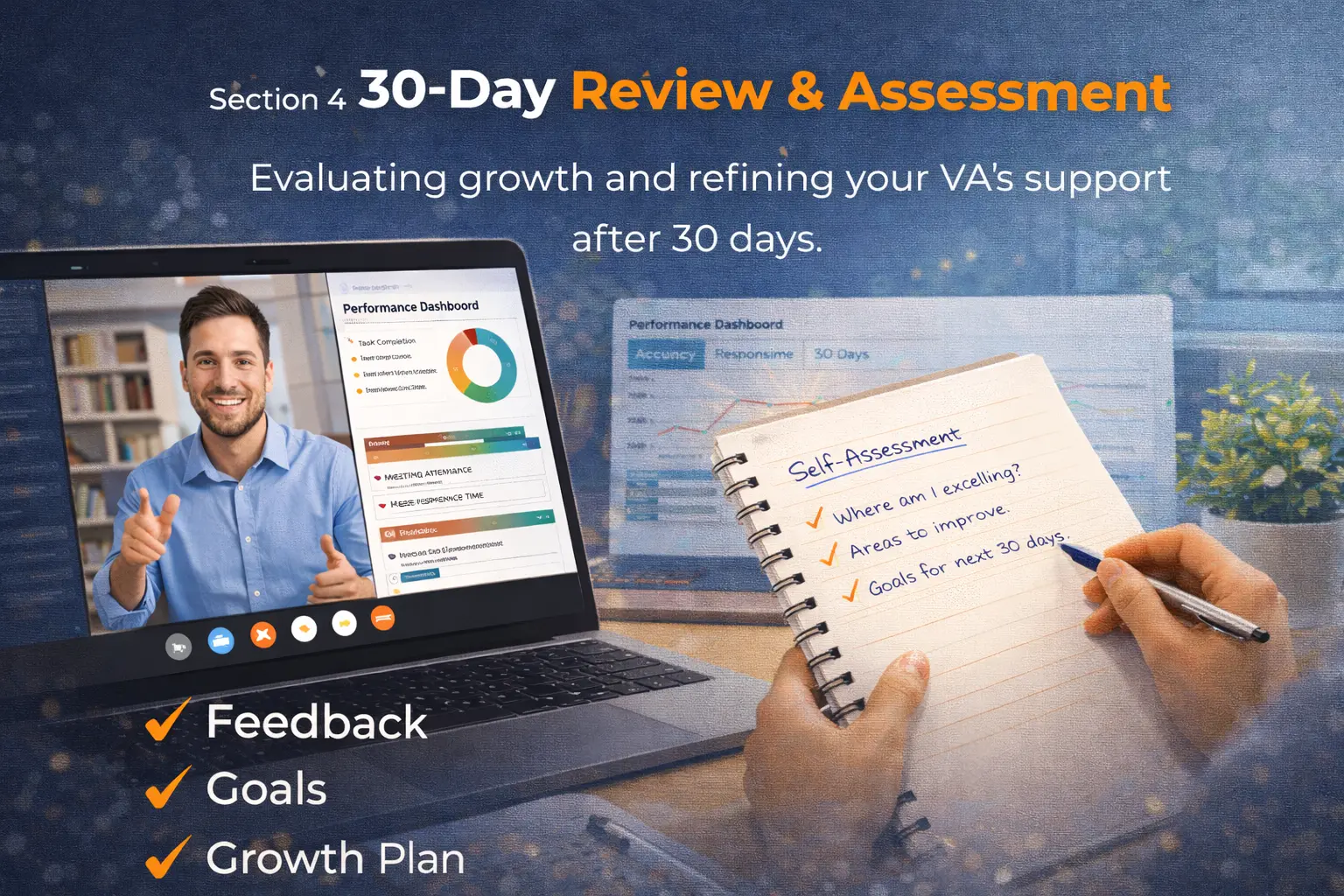
Week 4 is your 30-day performance checkpoint. This is when you formally assess whether the working relationship is on track, identify adjustment areas, and set clear expectations for the next 60-90 days.
30-Day Performance Review
Schedule a dedicated 60-90 minute video call for this review. Prepare a structured agenda and share it with your VA 48 hours in advance so they can self-assess and come prepared with questions.
Performance Review Structure
Part 1: Wins and Accomplishments (15 minutes)
Start positive. Acknowledge specific contributions and growth you've observed. Examples:
'You've mastered our CRM faster than expected—your data entry is accurate and thorough.'
'Your proactive communication has been excellent. I always know the status of your tasks.'
'The project you delivered last week was exactly what I needed—great attention to detail.'
Part 2: Areas for Improvement (20 minutes)
Provide constructive feedback using the 'situation-behavior-impact' framework:
Situation: 'Last Tuesday when you sent the client email draft...'
Behavior: '...you didn't include the pricing attachment I mentioned.'
Impact: 'This caused a delay in the proposal, and I had to follow up separately.'
Guidance: 'Going forward, please double-check that all mentioned attachments are included before sending.'
Part 3: VA Self-Assessment (15 minutes)
Ask your VA to reflect on their first month. Key questions:
'What has been most challenging for you so far?'
'What do you feel most confident about in your role?'
'What could I do differently to support you better?'
'Are there any tools, processes, or training you need that you don't have?'
'Where do you want to grow in this role over the next 3-6 months?'
Part 4: Goals and Expectations for Months 2-3 (20 minutes)
Set clear objectives for the next 60 days:
Performance targets: 'By Day 60, you should be able to handle X independently'
Skill development: 'Let's get you trained on [new tool/process] by end of Month 2'
Expanded responsibilities: 'Once you're comfortable with current tasks, we'll add [new responsibility]'
Communication adjustments: Any changes to check-in frequency, reporting format, etc.
Feedback Frameworks
Effective feedback is the cornerstone of continuous improvement. Use these frameworks consistently:
The 3:1 Ratio (Positive to Constructive)
Research shows optimal performance improvement occurs when positive feedback outweighs corrective feedback 3:1. For every piece of constructive criticism, provide three specific compliments or acknowledgments.
Radical Candor: Care Personally + Challenge Directly
The best feedback combines genuine care for the person with direct, honest communication about performance. Avoid 'ruinous empathy' (being so nice you don't give needed feedback) and 'obnoxious aggression' (being harsh without empathy). Instead, show you care AND give clear, actionable feedback.
The 5-Minute Feedback Formula
State the specific behavior or outcome (not personality traits)
Explain the impact of that behavior
Ask for their perspective ('What happened from your point of view?')
Agree on next steps or changed approach
Follow up to ensure improvement occurred
Task Adjustment Decisions
Based on Week 4 performance, you may need to adjust task assignments. Use this decision framework:
When to Increase Responsibility
Add more complex tasks if your VA demonstrates:
Consistent quality (95%+ accuracy on recurring tasks)
Proactive problem-solving (identifies issues before you do)
Capacity (completes assigned work with time to spare)
Initiative (suggests improvements or asks for more responsibility)
Confusion about expectations (repeatedly asking the same questions)
Skill gaps (task requires expertise they don't yet have)
Reducing tasks is not a failure—it's strategic calibration. Better to master fundamentals before advancing to complexity.
The 'Red Flag' Decision: Continue or Part Ways?
The 30-day mark is an appropriate time to assess cultural and performance fit. Consider parting ways if you observe:
Fundamental skill gaps that cannot be trained (e.g., you need advanced Excel, they have basic proficiency)
Communication breakdowns despite multiple attempts to clarify expectations
Cultural misalignment (work style, values, or approach fundamentally incompatible)
Lack of improvement after specific, documented feedback
Your intuition: If you consistently feel the fit isn't right, trust that instinct
If you decide to part ways, do so professionally and kindly. Provide honest feedback about why the role wasn't the right fit, offer a reference if appropriate, and ensure you follow proper termination procedures per your contract.
Month 1 Review Checklist
☐ 30-day performance review scheduled and completed
☐ Specific accomplishments documented and shared
☐ Constructive feedback provided with specific examples
☐ VA self-assessment conducted (challenges, wins, support needs)
☐ Training or skill development plan created (if needed)
☐ Decision made: continue with current trajectory or make significant changes
☐ Next review date scheduled (recommended: 60-day check-in)
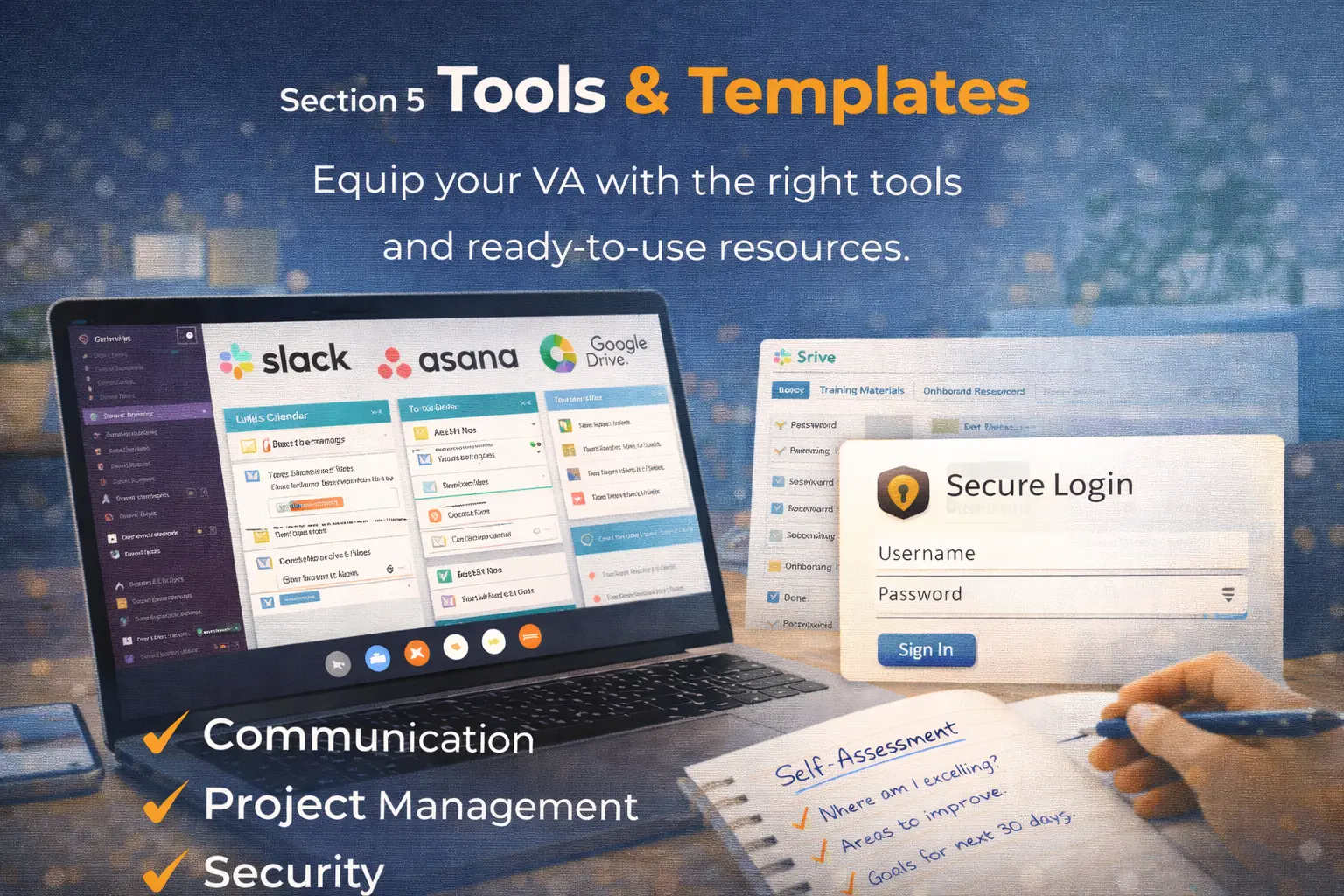
Section 5: Tools & Templates You'll Need
Successful VA onboarding requires the right tools and pre-built templates. This section provides guidance on setting up your tech stack and includes downloadable templates to accelerate your process.
Email Templates
Seven essential email templates are included in the downloadable template pack:
Welcome Email (Pre-Day 1)
Confirms start date, outlines Day 1 schedule, shares access credentials, sets tone
Day 1 Agenda
Meeting schedule, orientation topics, first tasks
Weekly Check-In Template
Recurring structure for weekly 1-on-1s: wins, challenges, goals
Feedback Email (Positive)
Template for acknowledging great work
Feedback Email (Constructive)
Template for addressing performance gaps
30-Day Review Invitation
Formal invitation to performance review with preparation guidance
Task Assignment Template
Structured format for delegating tasks (context, deliverable, deadline, resources)
Slack Setup Guide
Slack is the most common communication tool for remote teams. Configure it correctly from day one:
#project-[name]: Project-based channels for focused work
#random: Non-work socializing and team bonding
Direct messages: One-on-one conversations
Slack Etiquette to Teach
Use threads to keep conversations organized
React with emojis to acknowledge messages without creating notification noise
Set status when away, in a meeting, or on vacation
Use @mentions sparingly—only when you need immediate attention
Avoid 'Hey, quick question?' messages—just ask the question directly
Asana/Monday.com Integration Guide
Project management tools are essential for tracking VA tasks and deliverables. Whether you use Asana, Monday.com, ClickUp, or Trello, follow these setup principles:
Project Structure Best Practices
Create a dedicated project/board for your VA's tasks
Use columns/sections for task status: To Do, In Progress, Waiting on Feedback, Done
Set up recurring tasks for weekly/monthly responsibilities
Use priority flags (High/Medium/Low) to help your VA manage workload
Include detailed task descriptions with context, links to resources, and success criteria
Task Assignment Standards
Every task should include:
Clear title (action-oriented: 'Draft Q1 newsletter' not 'Newsletter')
Below is a comprehensive list of tools your VA will likely need. Not all apply to every role—customize based on responsibilities:
Category
Tools
Use Case
Communication
Slack, Zoom, Google Meet
Real-time messaging, video calls
Project Management
Asana, Monday, Trello, ClickUp
Task tracking, deadlines, workflows
File Storage
Google Drive, Dropbox, OneDrive
Document sharing, collaboration
Password Management
1Password, LastPass, Bitwarden
Secure credential sharing
CRM
HubSpot, Salesforce, Pipedrive
Customer data, pipeline management
Time Tracking
Toggl, Harvest, Clockify
Task duration, productivity metrics
Screen Recording
Loom, Snagit, CloudApp
Async training, process documentation
Email Management
Gmail, Outlook, Front
Inbox management, customer support
Social Media
Buffer, Hootsuite, Later
Scheduling, engagement, analytics
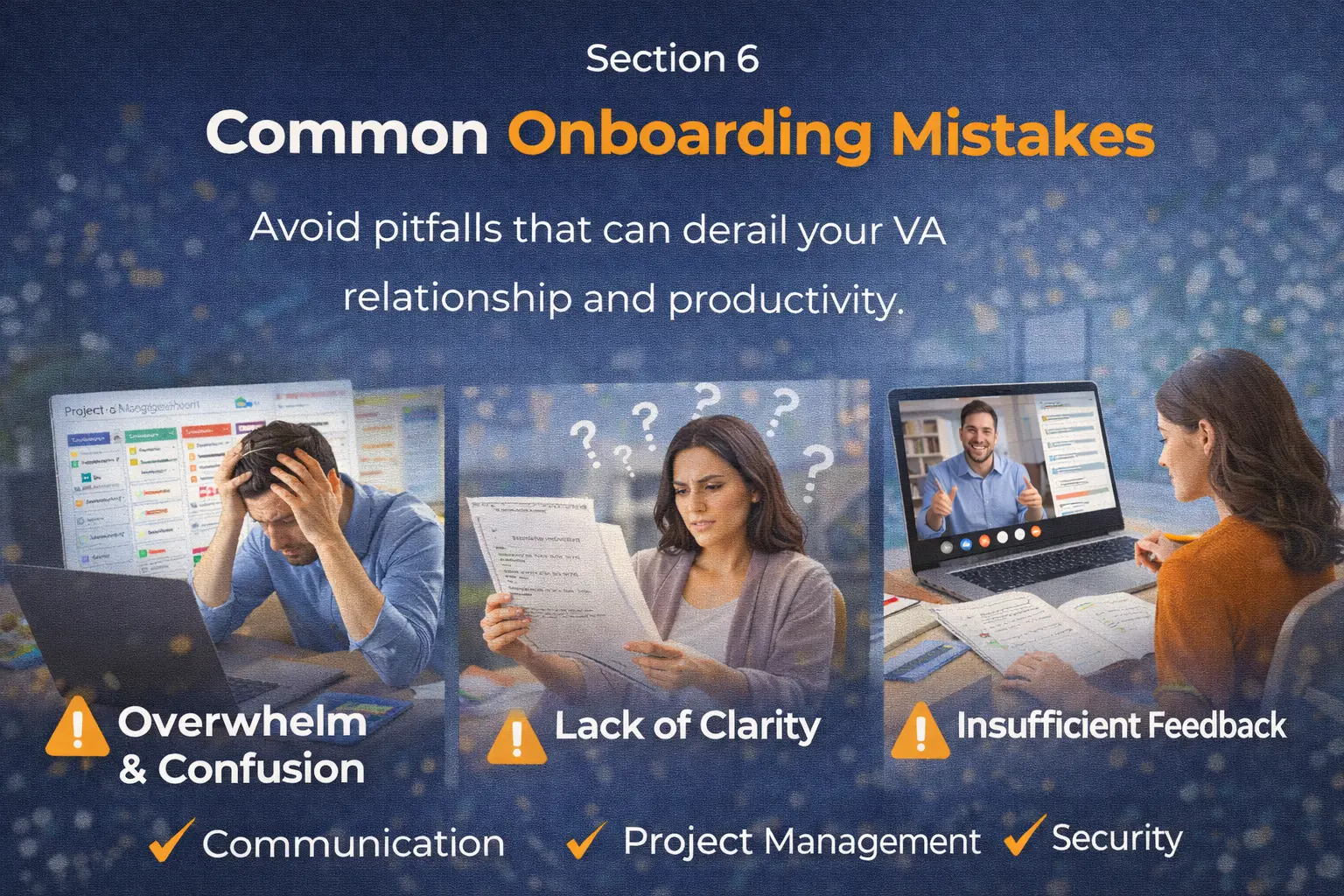
Section 6: Common Onboarding Mistakes to Avoid
Even experienced managers make predictable mistakes when onboarding virtual assistants. Learn from these common pitfalls to ensure your onboarding process succeeds.
Mistake #1: Assuming English Fluency Without Verification
'Bilingual' on a resume doesn't mean business-level English proficiency. Many Latin American professionals have conversational English but struggle with complex written communication, idioms, or industry-specific terminology.
How to Avoid:
Conduct language assessment during hiring (written test + verbal interview)
Set explicit communication standards during onboarding ('Use Grammarly for all external emails')
Provide style guides and templates for common communications
Be patient with language learning—provide constructive feedback on grammar and phrasing
Mistake #2: Rushing Task Assignment
The temptation to 'get value immediately' leads many managers to overload new VAs with tasks in Week 1. This creates overwhelm, errors, and damages confidence.
How to Avoid:
Follow the 60/40 rule in Week 1: 60% training, 40% tasks
Assign low-stakes tasks first (organizing files, reviewing documentation)
Gradually increase complexity—master simple before advancing to complex
Remember: Investing time in Week 1-2 training saves 10x time in Month 2+
Mistake #3: Skipping Cultural and Time Zone Training
Assuming 'work is work' ignores real cultural differences in communication style, feedback receptiveness, and decision-making authority.
How to Avoid:
Explicitly discuss communication norms: 'In our culture, direct feedback is valued. I'll give you specific suggestions—this means I care about your growth, not that I'm unhappy.'
Clarify decision-making authority: 'You can make these decisions without asking. For these decisions, ask me first.'
Set explicit working hours and response time expectations
Learn about Colombian holidays and work schedules (they differ from US)
Mistake #4: Not Documenting SOPs
Verbal instructions don't scale. Without written SOPs, your VA will repeatedly ask the same questions, and you'll become a bottleneck.
How to Avoid:
Record Loom videos for any process you explain more than once
Have your VA document processes as they learn them ('Please write the SOP for how you just completed that task')
Managers often wait until a problem becomes critical before addressing it. Meanwhile, the VA doesn't know they're underperforming and has no chance to correct course.
How to Avoid:
Provide real-time feedback: If something is wrong, address it within 24 hours
Use the 3:1 ratio: three positive comments for every constructive criticism
Schedule weekly check-ins for the first month, bi-weekly thereafter
Ask for feedback on your management: 'What can I do differently to support you better?'
Mistake #6: Treating VAs as 'Just Task-Doers'
Virtual assistants are professionals with careers, growth ambitions, and valuable insights. Treating them as order-takers creates disengagement and high turnover.
How to Avoid:
Share context with tasks: 'We're doing this because...' helps them understand the bigger picture
Ask for their input: 'How would you approach this?' or 'Do you see any issues with this plan?'
Invest in their development: Provide learning opportunities, new skills training, expanded responsibilities
Treat them as team members, not vendors
Mistake #7: No Clear Success Metrics
Without defined success criteria, neither you nor your VA knows if they're performing well. This creates anxiety and misaligned expectations.
How to Avoid:
Define 3-5 key performance indicators (KPIs) for the role
Share these metrics explicitly: 'Success in this role means: X, Y, and Z'
Review metrics together in 30-day and 60-day check-ins
Adjust metrics as the role evolves
Final Thoughts: Onboarding is an Investment
The time you invest in comprehensive onboarding pays exponential returns. A well-onboarded VA becomes a trusted team member who anticipates your needs, solves problems independently, and contributes meaningfully to your business growth.
Conversely, rushed or incomplete onboarding creates ongoing frustration, repeated mistakes, and eventual turnover—costing you far more time and money than you 'saved' by skipping proper onboarding.
Commit to the 30-day playbook outlined in this guide. Follow the checklists. Use the templates. Provide feedback consistently. The result will be a high-performing, long-term partnership that transforms your productivity and business capacity.
Appendix: Downloadable Resources Included
This comprehensive onboarding playbook includes the following downloadable assets to accelerate your VA onboarding process:
Pre-written, customizable email templates for welcome emails, feedback delivery, weekly check-ins, and performance reviews.
Need Help Hiring and Onboarding Your Virtual Assistant?
SharkHelpers connects US companies with pre-vetted, bilingual virtual assistants from Colombia and Latin America—and we manage the entire onboarding process for you.
✓ Pre-vetted talent with verified English proficiency


.png)
.png)
.png)
.png)

.webp)
.webp)
.webp)
